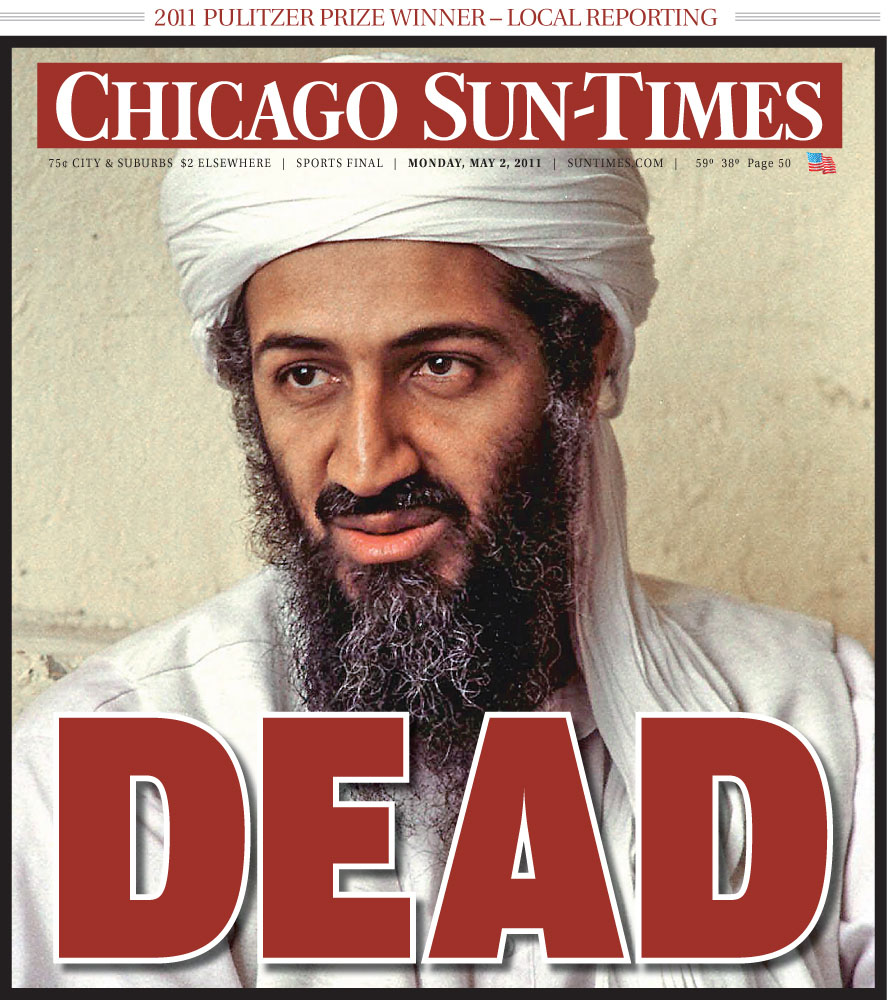
Fallout from the death of Osama bin Laden continues to ripple throughout the world.
Bin Laden's burial at sea has been criticized, even though that's a far better fate than the nearly 3,000 who were murdered at the World Trade Center. Some criticize that the US was too respectful, while others claim the US was not respectful enough. To me, that says that the US got it right - and I believe that the burial at sea was necessary to eliminate any possibility that his burial site could be treated as a rallying point.
As new details of the raid continue to leak out, the real questions are being pointed in the direction of Pakistan. What did they know and when did they know that bin Laden was living large in their country?
Pakistani President Asif Ali Zardari
submitted an op-ed in the Washington Post today in response to the US mission that killed Osama bin Laden in the town of Abbotabad, just miles from the Pakistani capital of Islamabad.
Let us be frank. Pakistan has paid an enormous price for its stand against terrorism. More of our soldiers have died than all of NATO’s casualties combined. Two thousand police officers, as many as 30,000 innocent civilians and a generation of social progress for our people have been lost. And for me, justice against bin Laden was not just political; it was also personal, as the terrorists murdered our greatest leader, the mother of my children. Twice he tried to assassinate my wife. In 1989 he poured $50 million into a no-confidence vote to topple her first government. She said that she was bin Laden’s worst nightmare — a democratically elected, progressive, moderate, pluralistic female leader. She was right, and she paid for it with her life.
Some in the U.S. press have suggested that Pakistan lacked vitality in its pursuit of terrorism, or worse yet that we were disingenuous and actually protected the terrorists we claimed to be pursuing. Such baseless speculation may make exciting cable news, but it doesn’t reflect fact. Pakistan had as much reason to despise al-Qaeda as any nation. The war on terrorism is as much Pakistan’s war as as it is America’s. And though it may have started with bin Laden, the forces of modernity and moderation remain under serious threat.
My government endorses the words of President Obama and appreciates the credit he gave us Sunday night for the successful operation in Khyber Pakhtunkhawa. We also applaud and endorse the words of Secretary of State Hillary Clinton that we must “press forward, bolstering our partnerships, strengthening our networks, investing in a positive vision of peace and progress, and relentlessly pursuing the murderers who target innocent people.” We have not yet won this war, but we now clearly can see the beginning of the end, and the kind of South and Central Asia that lies in our future.
Only hours after bin Laden’s death, the Taliban reacted by blaming the government of Pakistan and calling for retribution against its leaders, and specifically against me as the nation’s president. We will not be intimidated. Pakistan has never been and never will be the hotbed of fanaticism that is often described by the media.
Zardari is in a real tough position right now. He's got to simultaneously defend his country from claims that he was harboring al Qaeda's top dog, claiming that he was providing assistance (unidentified and uncorroborated by US officials who have studiously stated that they shared no aspects of this mission with any other country, including Pakistan), and has to be worried that the Islamists will try to topple his government because of its existing ties with the US (a belief that the government is complicit with the US even if there was no actual). Given the way that
Pakistanis love their conspiracy theories (even more than the nutjobs who think Osama wasn't real, wasn't killed, or any permutation thereof), all kinds of speculation is rampant in Pakistan right now over what Pakistan's government knew and when did they know of it.
Fact is, no one really knows what the Pakistani government knew about bin Laden's location, but it is highly suspicious that he was able to live in relative comfort in a compound just yards from the country's military academy and where military personnel go to retire. It is plausible that members of the military or the ISI were complicit in keeping bin Laden's whereabouts hidden but it once again indicates the difficulty of trusting the Pakistani government to reveal key details.
Those questions are being asked by members of Congress on both sides of the aisle - and they have good reason to ask those questions. Similar questions are being asked by other countries,
including the UK.
Zardari is right to state that his country has been ravaged by Islamic terrorists, particularly Taliban and al Qaeda. Yet, each time the Pakistani government (whether under Zardari or his predecessor, Pervez Musharraf) cracks down, it doesn't go far enough to eliminate the threat. It does just enough - anything more and the Islamists in the Pakistani government (Parliament, military, ISI) would thwart further action.
He further claims that radical Islamist parties make up a small fraction of his government, but that overlooks those other groups that lean towards radicalism and who do not condone crackdowns against the Islamists.
Pakistan barely maintains control over the frontier provinces, which are overrun with Taliban and have hosted al Qaeda for years on end. Efforts to thwart the Taliban have met with mixed success - and the body count among Pakistani soldiers is quite high and
The country can't align itself too greatly with the US for fear of assassinations or coups to install a more Islamist government, but doing nothing allows the Islamists free reign in the frontier provinces.
The question of what Pakistan knew and who knew might be revealed in the treasure trove of intel captured by the special forces team that carried out the mission. They recovered numerous computers, hard drives, thumb drives, and other intel that can be critical to unraveling the logistical network and other contacts, as well as identifying other key members and locations. It could also shed light on other planned or contemplated targets.
Bin Laden's death may also result in a reappraisal of ongoing military operations by the ISAF in Afghanistan, including the possible withdrawal of troops earlier than 2014. I think that would be a serious mistake, considering that al Qaeda and the Taliban remain a serious threat, and allowing them safe haven is a mistake.
Posted bylawhawk